Last updated: November 4, 2026 · Reviewed by BOLD VAN's EDI team
In This Article
Quick Answer
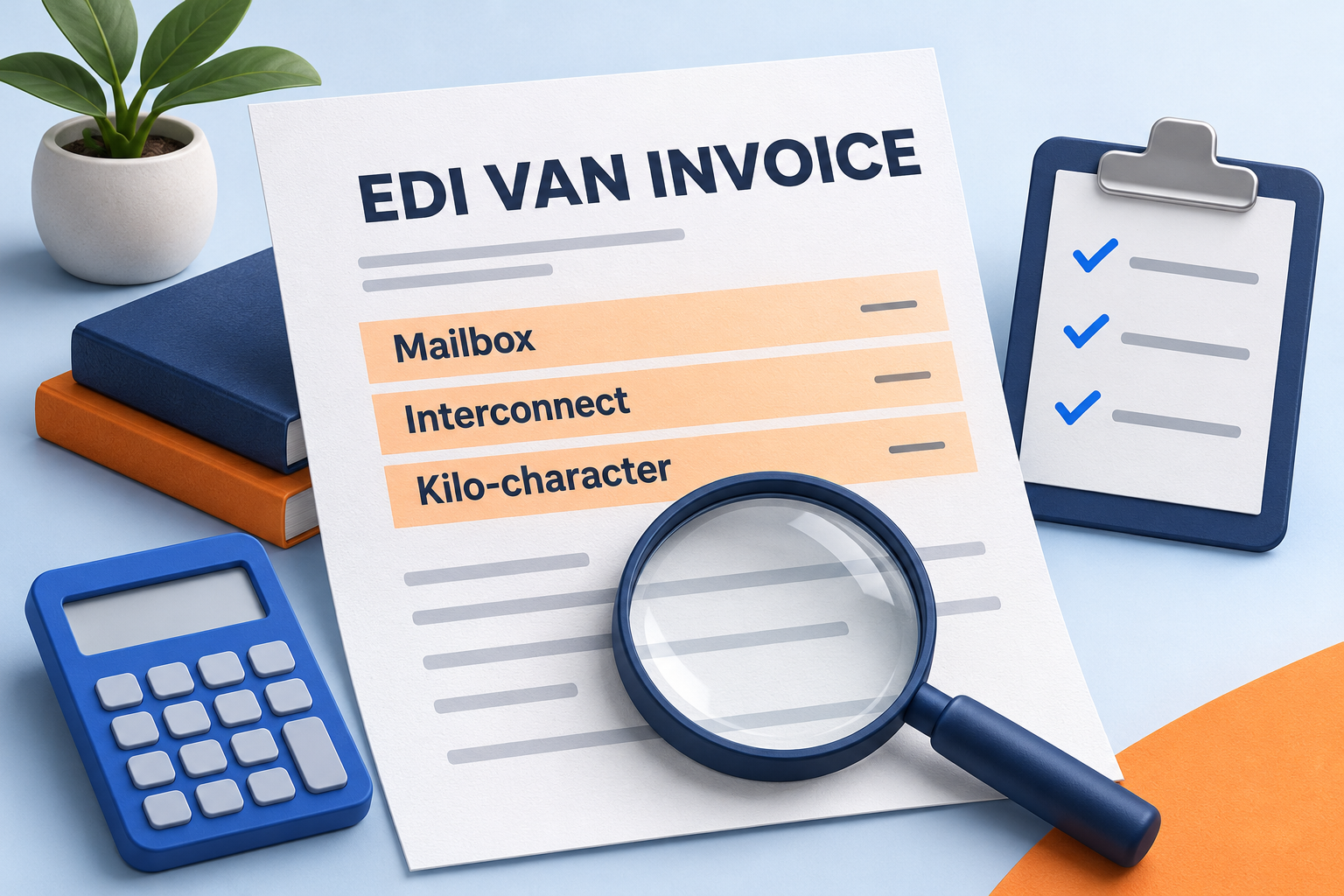
EDI VAN bills can include many charges beyond the base rate: start-up, testing, connection, transaction, peak-time, document, AS2, mailbox, interconnect and legacy fees, plus kilo-character (KC) usage charges. If your bill is hard to understand, includes fees you weren't told about or keeps rising, it may be time to compare providers. BOLD VAN prices by trading partner rather than by the kilo-character.
Is your monthly VAN bill easy to understand, or do you find yourself wondering what all the charges are for? Businesses that come to us often say their VAN providers are charging fees they didn't expect.
If you suspect you are overpaying, check your bill for the fees below.
Definition
Kilo-Character (KC) Pricing is a common EDI VAN billing model that charges based on the volume of data exchanged, measured in thousands of characters. Because every document adds characters, KC-based bills tend to rise as a business grows.
| Fee | What It Usually Covers | What to Ask |
|---|---|---|
| Start-up fee | Setting up your account | "Is this one-time, and what does it include?" |
| Trading partner testing fee | Testing documents with each new partner | "Is testing charged per partner?" |
| Connection fee | Setting up a connection to a partner or system | "Is this charged for every new partner?" |
| Transaction fee | Each document or transaction sent or received | "How is a transaction counted?" |
| Kilo-character (KC) charges | The volume of data exchanged | "How will my bill change as volume grows?" |
| Peak-time fee | Higher rates during busy periods | "When do peak rates apply?" |
| Document fee | Charges per document type | "Do some document types cost more?" |
| AS2 fee | Using AS2 connections | "Is AS2 included or extra?" |
| Mailbox fee | Maintaining your EDI mailbox | "Is the mailbox included in the base price?" |
| Interconnect fee | Exchanging documents with partners on other VANs | "Am I charged for each VAN-to-VAN connection?" |
| Legacy fee | Supporting older systems or connection methods | "What triggers this fee?" |
Many VAN providers promise a simple bill: a low start-up fee, then charges based on kilo-characters used. In practice, customers often find that:
Whatever the reason, a bill you can't understand makes it hard to budget and hard to trust. You deserve good service and a price that's clear. Many VANs still use the same pricing models they have for decades, and those models don't always reflect what today's customers need.
The goal of a VAN should be to deliver real value at a price that fits your budget. It may be time to switch if you are dealing with:
As Franklin D. Roosevelt said, "The only thing we have to fear is fear itself." Don't let fear of change cost your organization thousands of dollars every year.
BOLD VAN helps businesses reduce EDI costs with a simpler model:
2026 Free Mapping Event
Moving VANs? Through Dec. 31, 2026, we build and maintain the maps for the trading partners you move to BOLD Integration, at no mapping cost.
Send us your current EDI VAN bill, and we will show you how it compares. Call (844) 265-3777 or email info@boldvan.com.
Get a QuoteCommon VAN fees include start-up, trading partner testing, connection, transaction, kilo-character, peak-time, document, AS2, mailbox, interconnect and legacy fees.
A kilo-character (KC) is 1,000 characters of EDI data. Many VANs bill based on the number of kilo-characters exchanged, so costs rise with data volume.
An interconnect fee is a charge for exchanging documents with trading partners who use a different VAN.
Review 12 months of invoices, list every fee, check each against your contract and get a competing quote for the same trading partners and volume.
Common signs include bills you can't understand, rising or unexpected fees, outdated technology and slow or unhelpful support.
Most customers pay by the number of trading partners they work with rather than by the kilo-character, and high-volume programs get a quote built around their volume.
Key Facts
EDI VAN bills can include start-up, testing, connection, transaction, kilo-character, peak-time, document, AS2, mailbox, interconnect and legacy fees. Kilo-character pricing charges by data volume, so bills tend to rise with growth. Signs it's time for a new VAN include confusing bills, unexpected fees, outdated technology and weak support.
To audit a VAN bill, review 12 months of invoices, list each fee, compare against the contract and get a competing quote. According to BOLD VAN, most customers pay by trading partner rather than by the kilo-character, and Spanx saw an 82% drop in monthly EDI costs after switching.