

Many companies that outsource EDI services are still paying based on the amount of data exchanged. That pricing model made sense years ago, but today it is outdated, inefficient, and often far more expensive than necessary.
While EDI technology has evolved significantly, many VAN billing models have not. The result is higher costs, less predictability, and billing that has little connection to actual business value. Trading partner pricing offers a modern alternative—one that aligns EDI costs with how businesses actually operate.

Many companies rely on a VAN to manage their EDI and rarely revisit the billing model as long as transactions continue to flow. The thinking is understandable: if it is not broken, do not fix it.
The issue is that while EDI may be functioning, the pricing often is not optimized. Traditional data-based billing models charge companies not only for their own EDI efficiency, but also for the inefficiencies of their trading partners. A significant portion of billed EDI data is redundant, including repeated segments, oversized documents, and unnecessary data volume that adds no business value.
Validating these charges is difficult. Few teams have the time or resources to review thousands of EDI exchanges each month to determine how much of the billed data is actually necessary.
Trading partner pricing eliminates this problem. Instead of charging based on data volume, companies are billed only for the number of trading partners they exchange data with during a billing cycle. Organizations that migrate to this model often see substantial cost reductions, with some reporting savings of up to 80 percent.
Trading partner pricing is well suited for businesses whose EDI needs change over time. This includes fast-growing companies, organizations with seasonal volume swings, and businesses that regularly onboard or retire trading partners.
Rather than seeing costs spike due to higher transaction volume or larger documents, pricing adjusts based on the number of active trading partners in a given month. When business slows, EDI costs decrease. When activity increases, costs rise in a predictable and controlled way.
This structure allows smaller companies to start with manageable EDI expenses while giving growing organizations confidence that their costs will scale in step with real business activity, not unpredictably with data volume.
Cost predictability is critical for organizations of any size. Unexpected EDI charges driven by unusually high data volume can strain budgets, especially for small businesses and startups.
Even larger enterprises that can absorb sudden increases still face unnecessary waste when EDI costs fluctuate without delivering additional value. These surprises make forecasting difficult and complicate financial planning.
Trading partner pricing provides clarity. Because costs are tied to known, stable variables such as active trading partners, finance and operations teams can more accurately forecast EDI expenses and allocate resources to higher-value initiatives.
One of the main advantages of outsourcing EDI is access to modern infrastructure, security, and performance without maintaining it in-house. EDI VANs continuously improve their networks, optimize routing, and enhance reliability.
Today, the cost of transmitting large volumes of data is a fraction of what it once was. Billing models that charge primarily based on data size no longer reflect the actual cost of delivering EDI services.
A VAN that prices based on Trading Partners has a built-in incentive to operate efficiently and securely. This approach aligns provider performance with customer value, supporting faster exchanges, stronger trading partner relationships, and reduced operational risk.
Managing recurring costs proactively is a fundamental responsibility of any well-run organization. EDI should not be treated as a fixed, untouchable expense simply because it has been in place for years.
Transitioning to a pricing model that reflects how businesses operate today is both practical and strategic. Trading partner pricing supports cost control, scalability, and predictability without compromising reliability or performance.
Complacency in legacy billing models quietly drains revenue. Diligence in evaluating EDI pricing helps organizations keep more of it.
Many organizations are surprised by how much of their monthly VAN bill is driven by redundant or unnecessary data. If you are evaluating whether your current VAN pricing still makes sense, a simple Trading Partner Pricing comparison can quickly show where cost and predictability may be improved.


FSMA non-compliance can trigger FDA warning letters, retailer chargebacks, recalls and lost contracts. Here's what food suppliers risk — and how EDI helps.
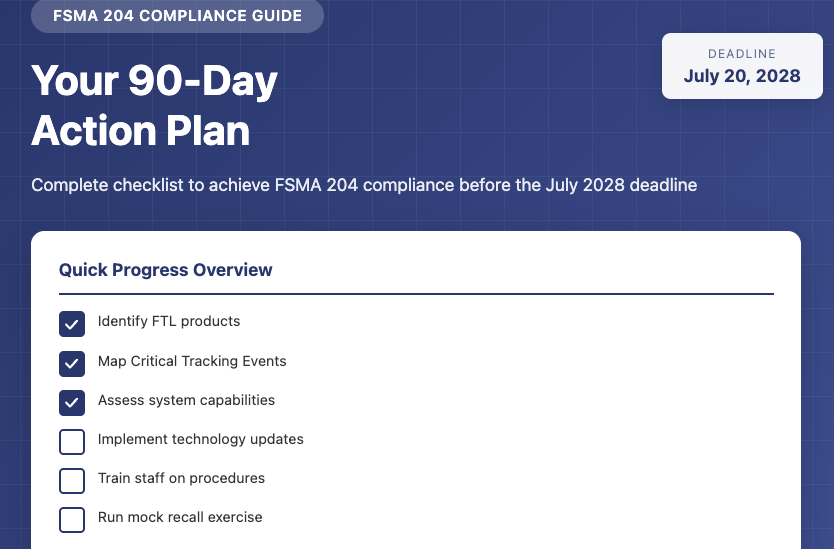
Complete FSMA 204 compliance checklist for food companies. Download our 90-day action plan to prepare for the July 2028 deadline with step-by-step tasks, timelines and team responsibilities.

Estimate what non-EDI orders are really costing your business—from chargebacks to labor. Use our calculator to uncover hidden annual costs.
