The FSMA 204 Food Traceability Rule introduces new recordkeeping requirements for companies that manufacture, process, pack or hold certain foods. At the center of these requirements are Key Data Elements (KDEs) — specific pieces of information that must be recorded at different points in the food supply chain. For businesses handling foods on the Food Traceability List, capturing these data elements accurately is essential for compliance and helps regulators trace food products quickly if a safety issue occurs.
What Are Key Data Elements (KDEs)?
Key Data Elements are the individual data points that must be recorded when certain events occur in the lifecycle of a food product. The FSMA 204 rule requires companies to capture KDEs during Critical Tracking Events (CTEs) — key stages in the movement or transformation of food products throughout the supply chain.
These data elements create a traceable record of how products move between trading partners and through different stages of production and distribution. Without detailed and accurate KDEs, tracing products through a complex supply chain during a food safety investigation can take days or even weeks.
For background on FSMA 204, see FDA Food Traceability Rule: What Food Companies Need to Know.
Understanding Critical Tracking Events (CTEs)
Before diving into the specific Key Data Elements required, it's important to understand Critical Tracking Events — the points in a food product's lifecycle where traceability information must be recorded.
The Five Critical Tracking Events
FSMA 204 identifies five types of Critical Tracking Events where companies must capture KDEs:
- Growing — Initial harvest or production of raw agricultural commodities on farms
- Receiving — Acceptance of food products from suppliers, growers or other trading partners
- Transforming — Processing, manufacturing or repackaging activities that change the food product
- Creating — First point where a food on the Food Traceability List is created as a finished product
- Shipping — Transfer of food products to customers, distributors or other supply chain partners
At each of these events, companies must record specific KDEs that describe the product, its origin and where it is going next. The specific data elements required vary depending on which CTE is occurring.

Food companies must capture Key Data Elements at each Critical Tracking Event to maintain FSMA 204 compliance
Common Key Data Elements Across CTEs
While the specific KDEs required under FSMA 204 vary depending on the type of Critical Tracking Event, several types of information appear frequently across different events. Understanding these common data points helps food companies design systems that can capture the necessary information efficiently.
Core KDEs Required Across Multiple Events
The following data elements are commonly required at various CTEs:
- Traceability Lot Code — A unique identifier assigned to a specific lot, batch or production run that allows the product to be traced throughout the supply chain
- Product Description — Clear identification of the food product, typically including the product name and any relevant variety or grade information
- Quantity and Unit of Measure — The amount of product involved in the transaction, expressed in appropriate units (pounds, cases, cartons, etc.)
- Location Identifiers — Information identifying physical locations where events occur, such as farm locations, processing facilities, warehouses or retail stores
- Date Information — Dates when events occur, such as harvest dates, receipt dates, processing dates or shipment dates
- Reference Document Numbers — Purchase order numbers, invoice numbers or other identifiers that link traceability records to business transactions
- Contact Information — Details for suppliers, receivers or other trading partners involved in the transaction
These data elements work together to create a comprehensive traceability record that documents how products move through the supply chain.
Key Data Elements by Critical Tracking Event
The specific KDEs required depend on which Critical Tracking Event is occurring. The following sections break down the key data requirements for the most common CTEs that food businesses encounter.
Receiving Event KDEs
When a company receives food products from a supplier or grower, the following Key Data Elements must typically be captured:
- Traceability lot code for the product received
- Product description
- Quantity and unit of measure
- Location from which the product was shipped (supplier/grower information)
- Date of receipt
- Reference document number (such as purchase order or receiving document number)
- Supplier contact information
Receiving Event Example
A food processor receives fresh tomatoes from a grower. The processor must record the grower's traceability lot code, the quantity received (e.g., 500 pounds), the grower's location identifier, the receipt date, and the purchase order number linking the shipment to their procurement records.
Transformation Event KDEs
Transformation events occur when food products are processed, manufactured or repackaged in a way that changes their form. This is one of the most complex CTEs because it involves both input and output traceability:
- Input KDEs: Traceability lot codes for all raw materials or ingredients used
- Output KDEs: New traceability lot code(s) assigned to the finished product
- Product description for both inputs and outputs
- Quantities of inputs consumed and outputs created
- Location where transformation occurred
- Date of transformation
The transformation event is critical because it links incoming ingredients to outgoing finished products, allowing traceability to flow through manufacturing operations.
Shipping Event KDEs
When shipping food products to customers or other trading partners, companies must capture:
- Traceability lot code for the product being shipped
- Product description
- Quantity and unit of measure
- Location to which the product is being shipped (customer/receiver information)
- Shipment date
- Reference document number (such as sales order or invoice number)
- Receiver contact information
Shipping Event Example
A distributor ships fresh-cut lettuce to a retail grocery chain. The distributor must record their assigned traceability lot code, the quantity shipped (e.g., 50 cases), the retailer's store or distribution center location, the ship date, and the sales order number.
KDE Data Elements Quick Reference Table
| Critical Tracking Event | Required Key Data Elements |
|---|---|
| Receiving | Traceability lot code, product description, quantity, supplier location, receipt date, reference number, supplier contact |
| Transforming | Input lot codes, output lot codes, product descriptions (input/output), quantities, processing location, transformation date |
| Shipping | Traceability lot code, product description, quantity, receiver location, ship date, reference number, receiver contact |
| Growing | Farm location, harvest date, product description, growing area coordinates, traceability lot code |
| Creating | Traceability lot code, product description, quantity, creation date, location, ingredient lot codes (if applicable) |
Why Key Data Elements Matter for Food Traceability
The purpose of collecting Key Data Elements is to improve the speed and accuracy of food traceability investigations. When a food safety issue occurs, regulators must quickly determine where the affected products originated and where they were distributed.
The 24-Hour Requirement
Under the FSMA 204 rule, companies must be able to provide traceability records to the FDA within 24 hours if requested during a food safety investigation. This requirement underscores the importance of maintaining organized, accessible records that can be quickly retrieved and shared.
Without detailed KDEs, tracing products through a complex supply chain can take days or even weeks. This delay can result in:
- Prolonged public health risks as contaminated products remain in the market
- Broader product recalls affecting products that were not actually contaminated
- Greater economic impact on food businesses and trading partners
- Loss of consumer confidence in food safety
Accurate KDEs help create a clear record of product movement so investigators can identify affected shipments quickly and remove contaminated products from the market while minimizing unnecessary recalls.
How Companies Capture and Manage KDE Data
Many food companies already collect some traceability information through existing business systems. However, the FSMA 204 rule requires organizations to ensure that this information is captured consistently across the supply chain and includes all required data elements.
Technology Solutions for KDE Capture
Common tools and systems used to capture Key Data Elements include:
- Enterprise Resource Planning (ERP) Systems — Centralized platforms that manage production, inventory and shipping data across the entire organization
- Warehouse Management Systems (WMS) — Software that tracks product movement, lot numbers and storage locations throughout fulfillment operations
- Barcode and Lot Tracking Tools — Systems that capture product identifiers and link them to specific lots, batches or production runs
- Electronic Data Interchange (EDI) Platforms — Automated systems that exchange shipment and product data electronically with trading partners
- Traceability Software Platforms — Purpose-built applications designed specifically to capture, store and retrieve traceability data according to regulatory requirements
The Role of EDI in Capturing KDEs
Electronic Data Interchange plays an important role in capturing and exchanging Key Data Elements between trading partners. Many retailers and distributors require suppliers to send EDI 856 Advance Ship Notices (ASNs) that include shipment details, product identifiers and lot numbers.
These electronic transactions can automatically capture many of the KDEs required for shipping events, including:
- Product identifiers and descriptions
- Traceability lot codes
- Quantities and units of measure
- Shipment dates
- Reference document numbers (purchase orders, invoices)
- Location identifiers for shipping and receiving locations
By automating KDE capture through EDI, food companies can reduce manual data entry errors, ensure consistent data formats across trading partners and maintain electronic records that can be quickly retrieved during investigations.
For more information on how EDI supports FSMA 204 compliance, see Do You Need EDI for FSMA 204 Compliance? How EDI 856 ASNs Enable Food Traceability.

Accurate recordkeeping of Key Data Elements enables rapid traceability during food safety investigations
Who Must Track Key Data Elements?
Companies must capture Key Data Elements whenever a Critical Tracking Event occurs for foods on the Food Traceability List.
The rule applies to businesses that:
- Grow or harvest raw agricultural commodities on the FTL
- Manufacture food products containing FTL foods
- Process food products on the FTL
- Pack or repackage FTL foods
- Hold FTL foods for distribution (warehouses, distributors)
- Retail FTL foods (in some cases, depending on the product and business model)
If a company handles foods included on the Food Traceability List, it must ensure that KDEs are captured and maintained according to the requirements of the FSMA 204 rule.
Preparing for FSMA 204 KDE Requirements
The FSMA 204 Food Traceability Rule requires companies to maintain detailed records of how certain foods move through the supply chain. Key Data Elements play a central role in this process by documenting the information needed to trace products from origin to destination.
Steps to Prepare for KDE Compliance
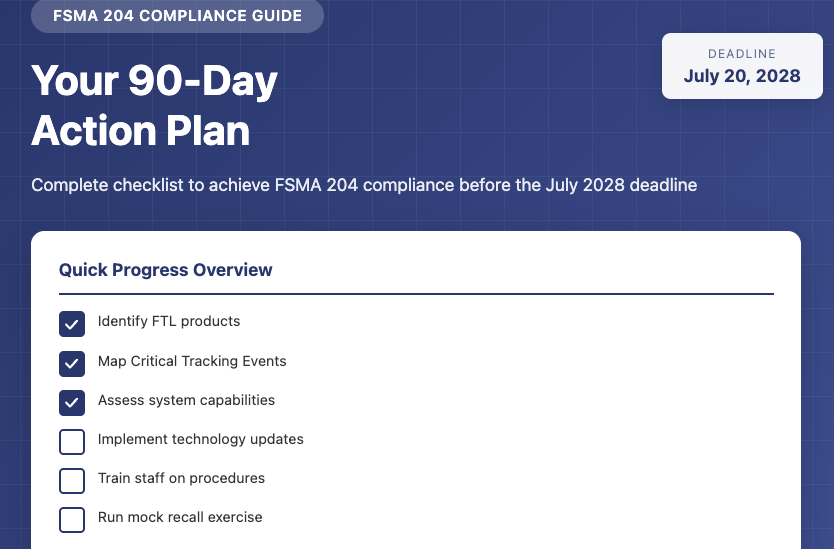
As organizations prepare for these requirements, recommended preparation activities include:
- Identify your CTEs — Map out where Critical Tracking Events occur in your operations (receiving, processing, shipping, etc.)
- Determine required KDEs — For each CTE, identify which specific Key Data Elements must be captured based on FDA guidance
- Assess current systems — Evaluate whether your existing systems (ERP, WMS, EDI) capture all required data elements
- Close data gaps — Implement processes or system enhancements to capture any missing KDEs
- Standardize lot coding — Develop consistent procedures for assigning and maintaining traceability lot codes
- Test traceability — Conduct mock recalls or traceability exercises to verify you can retrieve KDEs within 24 hours
- Train staff — Ensure teams understand which data elements must be captured and when
- Coordinate with trading partners — Align on data formats and exchange methods for sharing KDEs electronically
Many organizations are evaluating systems that help capture and share shipment data across trading partners. Technologies such as ERP platforms, barcode tracking systems and EDI solutions like BOLD VAN can help automate the exchange of traceability information and improve visibility across the supply chain.
Frequently Asked Questions
What is the difference between a KDE and a CTE?
A Critical Tracking Event (CTE) is a specific point in the food supply chain where traceability information must be recorded, such as receiving, processing or shipping. A Key Data Element (KDE) is a specific piece of information that must be captured during that event, such as the lot code, quantity or date.
Do all food companies need to track KDEs?
Only companies that handle foods on the Food Traceability List (FTL) must track KDEs according to FSMA 204 requirements. However, many companies apply similar practices to all products for consistency and operational efficiency.
How long must KDE records be maintained?
FSMA 204 requires traceability records to be maintained for two years. Records must be available for FDA inspection and must be retrievable within 24 hours if requested during a food safety investigation.
Can KDEs be captured manually or must they be electronic?
FSMA 204 does not mandate electronic systems. However, given the 24-hour retrieval requirement and the volume of data involved, most companies find that electronic systems (ERP, WMS, EDI) are necessary to efficiently capture, store and retrieve KDEs.
What happens if a company cannot provide KDEs within 24 hours?
Failure to provide required traceability records within 24 hours during an FDA investigation could result in regulatory action, including warning letters, recalls or other enforcement measures. This underscores the importance of maintaining organized, accessible records.